

Harvarrd Archaeological Study Shows: The Dinosaurs Had It Coming
$3.4 Million Well Spent

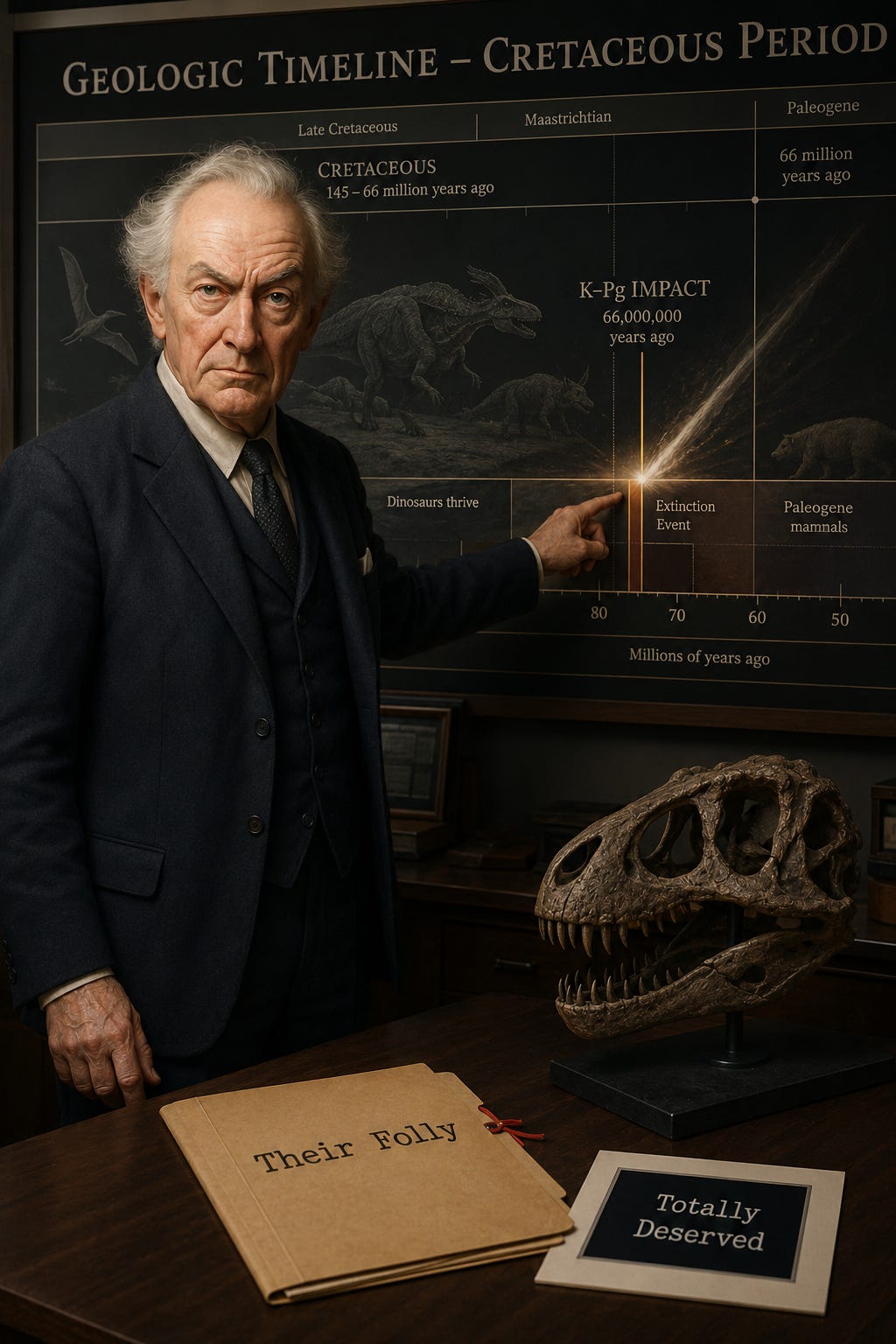
For sixty-six million years, the dinosaur has enjoyed a reputation it did not earn.
Beloved. Celebrated. Immortalized in museums, children’s films, and the kind of merchandise that confirms adults have simply stopped trying. The prevailing narrative — that the dinosaur was a magnificent creature, cut down in its prime by a random asteroid, a tragic casualty of cosmic indifference — has gone unquestioned for decades.
Harvarrd has questions.
“We are not in the business of comforting narratives,” said Dr. Edmund Fossworth, Chair of Harvarrd’s Department of Retrospective Behavioral Accountability™. “We are in the business of correct ones. And the correct one is this: the dinosaurs made choices. The asteroid simply responded.”
Forty-one researchers. Three field expeditions. One incident involving Greg and a fossil bed in the Badlands that we will not be discussing further. $3.4 million dollars.
The findings were not sympathetic.
Finding One: The Dinosaurs Had 165 Million Years and Produced Nothing
Modern civilization — written language, architecture, the concept of a strongly worded letter — was built in approximately 6,000 years.
The dinosaurs had 165 million years.
They did not build a single structure. They did not develop trade routes. They did not convene a single academic institution, despite having more than adequate time to do so.
“We gave them every benefit of the doubt,” Dr. Fossworth said. “We looked for evidence of infrastructure, of organized society, of peer-reviewed anything. We found a footprint. We found a footprint and some teeth.”
“The teeth,” he added, “were not being used productively.”
Finding Two: Their Risk Management Was Nonexistent
Harvarrd’s Department of Existential Preparedness™ conducted a full retrospective risk audit of the Cretaceous period.
The asteroid that ended the dinosaurs was not small. It was not fast. It was, by all geological measures, the kind of threat that a civilization paying any attention whatsoever would have seen coming.
The dinosaurs were not paying attention.
They were, according to the fossil record, eating each other.
“A basic early warning system. A rudimentary response protocol. A single meeting about contingency planning,” Dr. Fossworth said, shaking his head slowly. “Any of these things. We would have accepted any of these things.”
The dinosaurs held no meetings.
The asteroid held all the meetings.
Finding Three: The Attitude Problem
The Tyrannosaurus Rex — the dinosaur most frequently celebrated, most frequently merchandised, most frequently depicted as a hero in popular media — had, according to Harvarrd’s behavioral reconstruction team, an attitude problem.
“We modeled the T-Rex’s social behavior across seventeen simulations,” said Dr. Fossworth. “In all seventeen, it did not once consider the feelings of the other dinosaurs. It was not a team player. It was not coachable. It had the largest head in the room and the shortest arms and somehow still believed it was winning.”
The T-Rex, Harvarrd concludes, was the kind of apex predator that would have been very difficult to work with.
“We are not saying it deserved to die,” Dr. Fossworth clarified.
A long pause.
“We are saying it did not deserve to not die.”
Finding Four: The Asteroid Was Not Random
This is the finding that required the most peer review.
Harvarrd’s Department of Cosmic Accountability™ — established specifically for this study, budget allocated accordingly — spent nine months analyzing the trajectory, timing, and impact site of the Chicxulub impactor.
The conclusion was unanimous.
“The universe,” Dr. Fossworth said, “has patterns. And the pattern here is consistent. The asteroid did not arrive randomly. It arrived after 165 million years of the dinosaurs not doing anything about the asteroid situation. At some point the universe stops waiting.”
“We have all worked with someone like this,” he added. “We all know how it ends.”
Harvarrd does not celebrate the extinction of the dinosaur. Harvarrd is an institution of compassion, rigor, and correct opinions, and it takes no pleasure in this.
But the record must be set straight.
The asteroid did not end the dinosaur.
The dinosaur’s choices created the conditions in which an asteroid became the logical next step.
Harvarrd has ruled accordingly.
Published in the Harvarrd Journal of Retrospective Accountability and Deep Time Behavioral Science, under the category: Peer-Reviewed Extinction Analysis That Checks Out Geologically.